



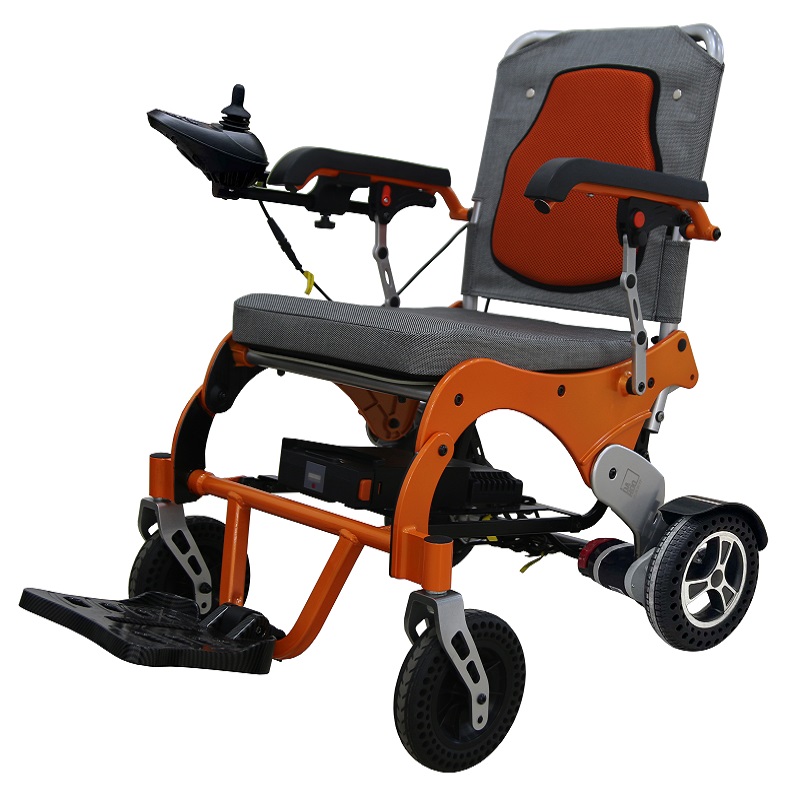




Electric wheelchairs are battery-powered smart mobility devices, requiring frequent charging and discharging during daily use.
Charging habits directly affect battery life, safety, and the overall performance of the electric wheelchair.
Many people have noticed:
Some manufacturers recommend "charging to 100%";
While some users say "it's best to charge to only 80% for longer durability."
——Which statement is correct?
To get the accurate answer, we must first understand the types of batteries used in electric wheel chairs and their working principles.

What type of battery does an electric wheelchair typically use?
The core power source for electric wheel chairs is the battery, which is currently mainly divided into three types:
1. Sealed Lead-Acid Battery
• Low cost, impact-resistant, but heavy;
• Generally has a lifespan of about 300-500 cycles.
2. Lithium-ion Battery
• High energy density, lightweight, long battery life;
• Lifespan approximately 800-1200 cycles.
3. Lithium Iron Phosphate Battery
• Higher stability, stronger safety;
• Can be cycled more than 2000 times.
Electric wheelchair manufacturers use different types of batteries in different price ranges, therefore the "charging strategy" must also vary depending on the battery type.

Why shouldn't electric wheelchair batteries be charged to 100% for extended periods?
From an electrochemical perspective, all battery types have an "optimal charging range."
Charging to 100% extends battery life, but increases internal battery pressure and shortens lifespan.
1. Relationship between Battery Voltage and Lifespan
Taking lithium-ion batteries as an example:
• At 100% charge, the voltage is approximately 4.2V;
• If only charged to 80%, the voltage is approximately 4.0V.
For every 0.1V increase, the battery's chemical stress index increases exponentially.
This means that every time the battery is fully charged, it pays a price in terms of lifespan.
2. Side Effects of Prolonged Full Charge
• Increased cell temperature → Accelerated aging;
• Increased internal resistance → Decreased discharge efficiency;
• Electrolyte oxidation → Increased risk of battery swelling;
• Extended charging time → Prolonged charger overheating.
Therefore, for users who frequently use electric wheel chairs, charging to 80%-90% each time is a more scientific and durable choice.
Will charging an electric wheelchair to only 80% affect its range?
It will indeed have some impact, but the impact is far less than people imagine.
For a typical electric wheelchair:
• A full charge provides a range of 25 kilometers;
• When charged to 80%, the range is approximately 20 kilometers.
Losing 20% of battery power can extend battery life by 30% to 50%.
This is a typical example of "sacrificing a little range for a longer lifespan."
For daily urban commuting or indoor use, this compromise is very reasonable.
When is it appropriate to charge to 100%?
While charging to 80% is better from a lifespan perspective, this isn't always the case.
The following scenarios are suitable for fully charging an electric wheelchair to 100%:
1. Long-distance travel required
For example, travel, outdoor activities, hospital transport, etc., where range is a high priority.
2. Before long-term storage
If the electric wheelchair is not expected to be used for more than a week, it is recommended to charge it to 100% and then unplug it for storage.
3. Low-temperature environments (below 10°C)
Battery capacity temporarily decreases at low temperatures; a full charge can compensate for this loss.
4. Battery level is too low (below 20%)
A full charge is necessary to ensure the battery voltage returns to a safe range.
Therefore, whether to charge to 100% should be determined flexibly based on the usage scenario, rather than blindly "charging only 80%" or "fully charging every time."

Does charging to 100% make electric wheelchairs more dangerous?
With compliant equipment and correct operation, a full charge is not "dangerous." However, using a non-original charger or overcharging does pose potential risks.
1. Overcharging Risks
Leaving the power cord plugged in for extended periods can lead to:
• The battery remaining under high voltage;
• The charger continuously overheating;
• Unceasing the internal chemical reactions of the battery.
Inferior chargers may cause battery swelling or fire risks.
2. Safety Recommendations
• Use the manufacturer's dedicated charger;
• Unplug the power cord after fully charging;
• Store in a well-ventilated, dry place while charging;
• Avoid leaving the power cord unattended near a bed or sofa for extended periods.
The correct charging method is more crucial than "how much charge."
What is the best way to charge an electric wheelchair to 80%?
Many users want to charge to 80% but worry about the lack of precise control.
Actually, you can achieve an "80% charging strategy" in the following ways:
1. Observe the charger indicator light
Most electric wheelchair chargers will display a red light while charging, turning green when nearly full.
Unplug the power cord about half an hour before the light turns green, which roughly corresponds to 80%-90%.
2. Calculate the time
If a full charge takes 6 hours, then charging for 4.5-5 hours will reach approximately 80%.
3. Use a smart charger
Some brands are equipped with intelligent control systems that allow you to set the charging cutoff voltage.
If your electric wheelchair supports this function, you can directly select "energy-saving mode" or "80% mode".
4. Monitor the voltage or battery level
Some high-end electric wheel chairs have a battery level display that can monitor the battery percentage in real time.
These methods allow for relatively accurate control even without sophisticated equipment.
Will frequently charging only to 80% cause a "memory effect"?
This is a common misconception.
The so-called "memory effect" primarily occurs in nickel-cadmium (NiCd) batteries.
However, modern electric wheel chairs almost entirely use lithium-ion or lead-acid batteries,
which do not exhibit a significant memory effect.
In other words:
Frequently charging to 80% will not affect battery capacity.
Conversely, frequently charging to 100% will accelerate aging.
Regularly (every 1-2 months) fully charging helps the system calibrate the battery level display.

What charging principles should electric wheelchair users follow?
To maximize battery life and ensure safety, electric wheelchair users should follow these five principles:
1. Shallow Discharge and Shallow Charge
Avoid charging when the battery level is too low (below 20%);
Avoid fully charging to 100% every time.
2. Regular Full Charges
Fully charge every 1-2 months to balance the cell voltage.
3. Suitable Temperature
The optimal charging temperature is 15°C–30°C;
Avoid charging in excessively hot or cold environments.
4. Do not charge while using
Using the battery simultaneously can cause current fluctuations, damaging the battery.
5. Allow to cool down after charging
After charging, allow the battery to cool naturally for 10-15 minutes before use.
These scientific charging habits are more important than simply discussing "80% or 100%".
How to schedule electric wheelchair charging most scientifically?
The scientific charging frequency should be combined with usage intensity:
Frequency of use | Recommended charging strategy | Charging limit |
| Daily use (e.g., for commuting) | Charge overnight, 80%-90% is sufficient | Full charge once a month |
| Several times per week | Recharge after use | Full charge once every two weeks |
| Occasional use | Fully charge before storing | Maintenance charge once a month |
When the battery is not in use for extended periods, recharge it every 1-2 months to prevent over-discharge damage.
What behaviors most easily shorten the battery life of an electric wheelchair?
The following incorrect charging or usage habits will significantly shorten the life of an electric wheelchair:
• Frequently "fully charging and then completely discharging";
• Leaving it plugged in for extended periods without interruption;
• Charging in hot, humid environments;
• Using non-original chargers;
• Charging before the battery is dry after rain;
• Not charging for extended periods without use.
These issues may seem like minor details, but they have a significant impact on battery life.
Charging to 80% Or 100% Depends on the Intended Use
Answering the core question:
"Is it better to charge an electric wheelchair to 80% or 100%?"
Intended Use | Optimal charging strategy | Reasons |
| Daily short trips | Charge to 80%-90% | Slow down battery aging and extend battery life |
| Long-distance or continuous use | Charge to 100% | Ensure battery range |
| Before long-term storage | Full charge | Prevent battery over-discharge damage |
| Extreme weather | It is not recommended to charge to full capacity | Prevent risks caused by overheating |
The most scientific conclusion is as follows:
In other words—"80% is more durable, 100% is more long-lasting."
The choice should be based on actual usage needs.
Scientific charging and regular maintenance will ensure your electric wheelchair maintains stable power and safety performance.
What makes Dayang Medical different from other suppliers in China?
Unlike many small suppliers, Dayang Medical is a certified manufacturer with two large production bases. We control every step from design and R&D to factory sales, which means buyers get direct prices and better discounts. Our products include electric wheel chairs, manual wheelchairs, commodes, beds, and shower chairs, all tested and certified.
Customers prefer to purchase from us because we combine cheap wholesale prices, reliable quotes, and high-quality output.
